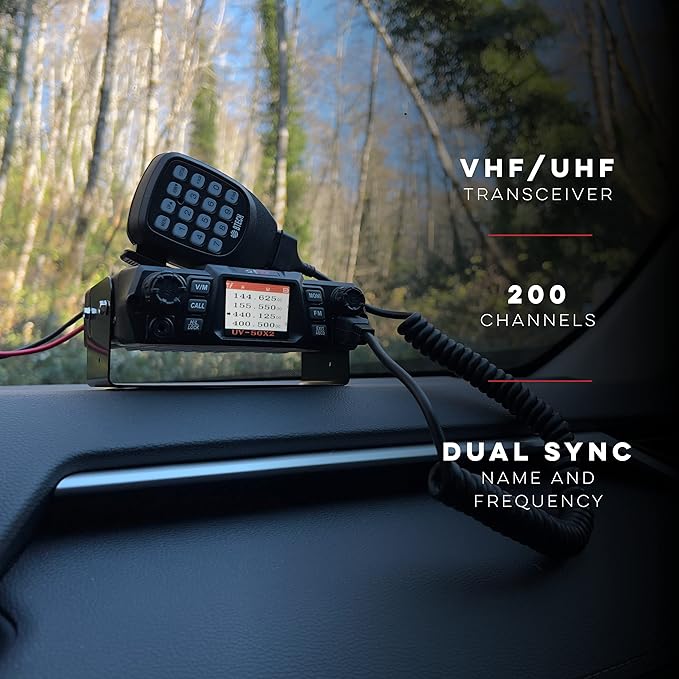
Ham radio (amateur radio) is a licensed radio service that lets operators transmit across a wide range of frequencies — including VHF, UHF, and HF bands — using a much broader set of privileges than license-free services like FRS or GMRS. Unlike a channelized radio, a ham radio is a blank slate: you can tune it to nearly any frequency within your license class's privileges, which makes it the most flexible radio system available to everyday operators.
What is ham radio (amateur radio)?
Ham radio is a two-way radio service regulated by the FCC (Part 97) that gives licensed operators access to dedicated frequency bands across HF, VHF, and UHF. Where a GMRS radio comes pre-programmed with a fixed set of channels, a ham radio isn't channelized — you enter the exact frequency you want to use, which is what gives ham operators access to far more bands, more power, and more communication modes (voice, digital, data) than any license-free option.
Do I need a license for ham radio?
Yes. Transmitting on ham radio frequencies requires an FCC amateur radio license, which means passing a written exam. There's no minimum age and no fee paid directly to the FCC for the license itself, though exam sessions typically charge a small administrative fee. Listening to ham radio traffic doesn't require a license — only transmitting does.
What are the different ham radio license classes?
There are three license classes, each unlocking more frequency privileges:
- Technician — the entry-level license most new operators start with. It covers most VHF/UHF privileges (including the popular 2-meter and 70cm bands) plus limited HF phone privileges on the 10-meter band.
- General — opens up most HF bands, which is what enables long-distance, cross-country communication.
- Amateur Extra — the highest class, unlocking the full amateur radio spectrum with no remaining restrictions.
Most preppers and emergency-comms users only need a Technician license to do everything they're after — local and regional VHF/UHF communication and repeater access.

How hard is the ham radio license test?
The Technician exam is a 35-question, multiple-choice test pulled from a fixed public question pool, covering radio theory, regulations, and basic operating procedure — including some math for calculating wavelength and using Ohm's law. Most people find it more overwhelming than genuinely difficult: the question pool is published in advance, and free tools like practice-test sites let you study by repetition until the material sticks. Plan on a few weeks of regular study sessions before testing.
Ham radio vs. GMRS vs. FRS — what's the difference?
The core difference is licensing and flexibility, not raw range:
- FRS — no license required, fixed low power (up to 2 watts), no repeater access. Fine for short-range, casual use only.
- GMRS — requires a license (no test, just a fee), channelized like FRS but with higher power (up to 50 watts on base stations) and repeater access.
- Ham radio — requires a license and passing an exam, but offers the most flexibility: multiple bands (HF/VHF/UHF), higher power limits, and the largest repeater network in the country.
On a handheld, simplex range between ham and GMRS radios is roughly comparable — the real advantage of ham radio is band flexibility and repeater availability, not dramatically longer range.
What frequencies/bands can ham radio operators use?
Ham radio operators have access to multiple bands, most notably:
- HF (High Frequency) — long-wavelength bands capable of skywave propagation, meaning signals can bounce off the atmosphere and travel across the country or around the world under the right conditions. Requires a General or Extra license for full access.
- VHF (Very High Frequency) — most commonly the 2-meter band, popular for local and regional simplex and repeater use.
- UHF (Ultra High Frequency) — most commonly the 70cm band, similar range characteristics to VHF and where GMRS also operates (just outside the ham allocation).
What's the range of a ham radio?
Range depends far more on terrain, antenna height, and whether you're using a repeater than on the radio itself. On a handheld using simplex (radio-to-radio, no repeater), expect roughly 1–6 miles depending on obstructions — VHF and UHF are both line-of-sight technologies, so hills, buildings, and trees will cut into that range. Tapping into a repeater changes the equation entirely, extending a handheld's effective range to 30–70+ miles in good conditions. HF, by contrast, can travel far greater distances by bouncing signals off the atmosphere, but that comes with a more complex, less predictable setup that's better suited to base stations than handhelds.
What is a ham radio repeater and how do I use one?
A repeater is a station — usually mounted on a mountain, tower, or tall building — that receives your transmission on one frequency and instantly rebroadcasts it on another, over a much larger area. Because repeaters sit high above the surrounding terrain, a low-power handheld can reach one from many miles away and get a huge range boost in return. To use a repeater, you'll need to program its frequency, offset, and access tone into your radio, and — unlike simplex use — you're expected to identify with your call sign, especially if the repeater is part of an organized net. Ham radio's repeater network is one of its biggest advantages: it's older and denser than the GMRS repeater network in most parts of the country, and it's rarely restricted to private groups the way some GMRS repeaters can be.
Curious how ham and GMRS repeater networks compare? Watch the full breakdown →
How much does a ham radio setup cost?
It really depends on what you're doing. A basic UHF/VHF handheld can run anywhere from about $20 to $400, depending on the brand and features — and for most beginners, that plus the one-time cost of the license exam covers everything needed to get on the air. HF is a different story entirely. Operating on HF requires a lot more infrastructure to do well, and that usually means a serious antenna build — some HF antenna setups alone can run into the thousands of dollars.
Frequently Asked Questions
Do I need a license just to listen to ham radio?
No — only transmitting requires a license. Anyone can listen to ham radio traffic without a license.
Does my GMRS license let me use ham radio?
No, they're separate licenses covering separate services. A GMRS license only authorizes GMRS frequencies, and a ham radio license only authorizes ham bands.
How long does a ham radio license last, and does it expire?
A ham radio license lasts 10 years and is renewable before it expires.
What's the difference between a ham radio and a GMRS radio if they look the same?
It's entirely about internal programming and what frequencies the radio is certified to transmit on — not the hardware shell. Many ham and GMRS radios share the same physical design.
Can I get a ham radio pre-programmed for my area?
Yes — see our custom radio programming service to get a ham radio programmed with the repeaters active in your area.