GMRS (General Mobile Radio Service) is a licensed radio service that gives everyday users access to powerful, long-range handheld and base station radios — without a test. For preppers, families, and anyone who wants reliable local communication, GMRS is the easiest entry point into serious radio, before ever touching Ham.
What is GMRS?
GMRS stands for General Mobile Radio Service — a radio band managed by the FCC that lets you legally transmit at up to 5 watts on a handheld (and up to 50 watts from a base station), well beyond the power of a toy walkie-talkie. Unlike Ham radio, GMRS is channelized: your radio comes pre-programmed with a fixed set of channels, so there's no need to learn frequencies or complex programming just to start talking.
GMRS shares its basic channels with FRS (Family Radio Service) — the low-power radios sold at big box stores — but GMRS radios add real transmitting power, removable antennas you can upgrade, and access to repeaters that dramatically extend your range.
Do I need a license for GMRS?
Yes — but it's simpler than most licenses. A GMRS license costs $35 through the FCC, requires no test, and covers your entire household under one license. You'll need a call sign for it, and you'll want an FRN (FCC Registration Number) to apply.
You technically need this license to transmit on GMRS at all, but it becomes essential the moment you want to access repeaters, since repeater owners and other users expect to hear a call sign. If range and repeater access matter to you, the license is worth it.
GMRS vs. FRS vs. Ham — what's the difference?
FRS (Family Radio Service) is the license-free option — the radios you'll find at Walmart or sporting goods stores. They're capped at 2 watts of power, operate on UHF only, have fixed non-removable antennas, and can't access repeaters. Good for a backyard or campsite, not much further.
GMRS shares the same basic channels as FRS but gives licensed users up to 5 watts on a handheld (50 watts from a base station), also on UHF, with removable/upgradeable antennas and access to repeaters — towers that relay your signal over a much larger area. It's channelized and pre-programmed, so it's simple to operate straight out of the box.
Ham radio is a different tier entirely. It's not channelized — a Ham radio is closer to a blank slate that can be programmed to operate across HF, UHF, and VHF, with power up to 1,500 watts on the right setup, giving far more flexibility and range potential, including HF bands capable of cross-country and international contacts. The tradeoff is a steeper learning curve and a required licensing exam.
Bottom line: FRS is for casual, short-range use. GMRS is the sweet spot for local and regional emergency communication with minimal setup. Ham radio is for those who want maximum flexibility and are willing to test for it.

What's the range of a GMRS radio?
Range depends far more on terrain, antenna height, and obstructions than on the number printed on the box — the "35-mile range" claims on bubble-pack radios assume zero obstructions, which almost never happens in the real world.
Realistically, a handheld GMRS radio talking directly to another handheld (simplex) will get you roughly 1–6 miles depending on terrain — less in hilly or wooded areas, more in flat open terrain with a clear line of sight. Getting your antenna elevated (rooftop, hilltop, tower) matters more than raw wattage; a 5-watt radio with a high antenna will consistently outperform a 50-watt radio with its antenna on the ground.
Repeaters change the equation entirely. Because a repeater sits high up and rebroadcasts your signal with much more power, a handheld can commonly reach a repeater 20–50+ miles away, and the repeater itself may cover a 20–30 mile radius. Two handhelds relaying through a well-placed repeater can effectively communicate across 100+ miles combined.
One practical note: radio range is measured line-of-sight, not driving distance — a repeater "30 miles away" on a map is often much closer than 30 road miles, since the signal travels straight over hills and buildings that a car would have to go around.

What frequencies/channels does GMRS use?
GMRS operates in the UHF band between 462 MHz and 467 MHz, split across 22 channels. Channels GMRS adds 8 repeater capable channels.

Channels 15–22 do double duty as the repeater input/output pairs — when you're transmitting to a repeater, your radio shifts up in frequency (typically a +5 MHz offset) while listening on the standard channel. This is why the same repeater can show up numbered differently depending on the radio brand you own — some label repeater channels 15–22, others 1–8, and others 23–30. They're the same frequencies underneath; only the labeling differs by manufacturer. If you're programming a repeater manually, always confirm by frequency, not by channel number, to avoid confusion between brands.
What is a GMRS repeater and do I need one?
A repeater is a radio — usually mounted on a tower, mountain, or tall building — that receives your transmission on one frequency and instantly rebroadcasts it on another, over a much larger area than your handheld could reach on its own. Because repeaters sit high above ground-level obstructions, they let a 5-watt handheld cover ground that would otherwise require a massive base station setup.
You don't need a repeater to use GMRS — simplex (radio-to-radio) communication works fine for shorter, local distances. But if you want reliable regional coverage — coordinating with family across town, or with a group during an emergency — a repeater is what makes that realistic.
A common concern is that repeaters will go down during a power outage. In practice, most maintained repeaters run on solar and battery backup specifically for this reason, and many are built to run indefinitely without grid power. Repeaters requiring a license to access are found through sites like RepeaterBook or myGMRS.com, where you can search by location before programming one into your radio.
How much does a GMRS radio cost?
A basic GMRS handheld typically runs from $20-$150 comparable in price to an entry-level Ham handheld — budget for the radio itself plus the $35 FCC license (a one-time cost covering your whole family). Base station setups cost more once you factor in a higher-wattage radio, an external antenna, coax, and mounting hardware, and can run into hundreds of dollars for a serious setup. Compared to building out a full multi-band Ham radio system, GMRS is a far lower up-front investment for local and regional coverage, which is part of why it's a popular starting point before moving into Ham radio.
Best GMRS radios for beginners
For a first GMRS radio, look for three things: a genuine GMRS-certified radio, a removable antenna so you can upgrade later, and — if you'll be using it outdoors — a waterproof housing. A dedicated handheld GMRS radio in a rugged, sealed case is a solid starting point for most buyers, since it's built specifically for outdoor and emergency use rather than adapted from a Ham design.
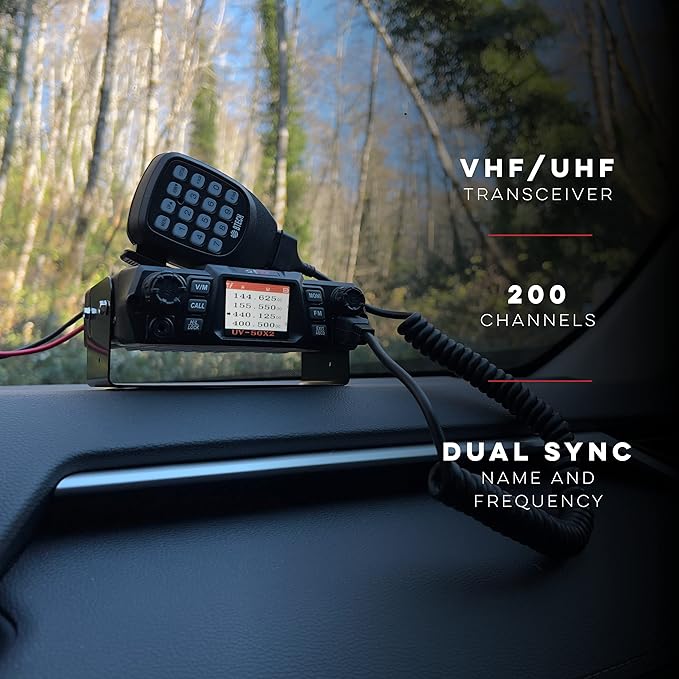
For a home base, pair your handhelds with a higher-wattage base station radio and an elevated external antenna — this combination does more for your real-world range than upgrading any single handheld.
Frequently asked questions
Can a GMRS radio talk to a Ham radio?
Not directly out of the box — they operate on different frequency plans. A Ham radio can be manually programmed with GMRS frequencies, but a standard GMRS radio can't transmit on Ham-only frequencies since it's locked to the GMRS channel plan.
Do GMRS repeaters go down during power outages?
Most don't. The majority of maintained repeaters run on solar and battery backup specifically to stay online during grid outages, though this varies by owner.
What antenna do I need for a GMRS radio?
Use an antenna rated for the 462–467 MHz range specifically. A Ham radio antenna that isn't tuned for GMRS frequencies will cause weaker signal and dropouts, even though it may physically fit your radio.
Can I use GMRS without a license?
No — transmitting on GMRS frequencies requires a $35 FCC license. It's required to use the band at all, and essential if you plan to access repeaters.
How is GMRS different from CB radio?
CB operates on HF frequencies with no repeater access, making it inconsistent for reliable local range. GMRS operates on UHF, supports repeaters, and is generally more consistent for local and regional emergency communication.