If you've spent any time on GMRS or ham frequencies, you already know the problem: anyone else nearby with a simple analog radio on those same frequencies can hear every word — no scanner required. DMR (Digital Mobile Radio) changes that equation. It's a digital mode — not a different radio service, just a different way of encoding your voice — and that one difference is why it's becoming the go-to choice for preppers, retreat networks, and anyone who wants their comms off the casual listener's radar.
This guide covers what DMR actually is, why digital beats analog for privacy even before encryption enters the picture, what AES-256 encryption on a DMR radio really does, and how to set one up for your own group — plus where the legal lines actually sit, so you're not finding out the hard way.
What Is DMR? Digital vs. Analog, Explained
DMR is simply a mode, the same way single sideband, FM, or AM are modes on an old CB set. A single dual-mode radio can run standard analog FM on GMRS or ham frequencies exactly like any other handheld, and it can also be switched into a digital mode on those same frequencies. Flip a GMRS or ham channel from analog to digital, and a standard analog radio doesn't hear garbled speech — it hears nothing at all, because analog gear physically can't decode a digital signal. That's not the same as being undetectable, though: a digital-capable scanner, or another DMR radio running the same protocol, can pick that traffic up and decode it just fine. The privacy advantage of digital mode is that it locks out casual listeners running ordinary analog gear — not that it hides your signal from everyone.
| Signal Type | Heard by an analog radio or basic scanner? | Heard by a digital scanner or another DMR radio? |
|---|---|---|
| Analog FM (standard GMRS/ham) | Yes, in the clear | Yes, in the clear |
| DMR digital (no encryption) | No — analog gear can't decode a digital signal | Yes — fully readable, no key needed |
| DMR digital + AES-256 encryption | No | No — not decodable without the matching key |
Why DMR Is Harder to Eavesdrop On Than GMRS or Ham
Even with zero encryption turned on, digital mode already gives you a real privacy advantage over analog: casual listeners running a basic analog GMRS/ham radio or a standard analog scanner simply can't decode digital traffic. That's a baseline layer of privacy most people never get from standard analog gear — though it's worth being clear that a digital-capable scanner, or another DMR radio, can still hear and decode unencrypted digital traffic without any trouble.
DMR radios also organize channels into talk groups (sometimes paired with a radio ID and color code), and radios only communicate cleanly with others programmed into the same talk group on the same channel. Someone running a digital scanner in "digital monitor" mode could technically pick up traffic in an unfamiliar talk group. In practice, though, it's unlikely anyone would casually stumble across your specific traffic — there's a huge number of channels and frequencies already in use across the ham bands in digital mode, and finding your particular talk group by chance is like finding one conversation in a stadium.
DMR Encryption: What It Actually Does (and What's Just Marketing)
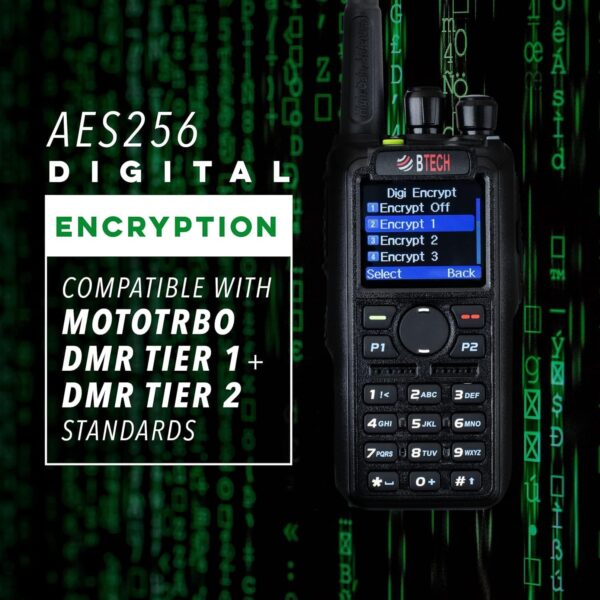
This is where DMR pulls ahead of anything analog. On radios like the BTECH DM-6X2, you can set channels to AES-256 encryption. Every radio in the group needs the same encryption key loaded into its programming. Turn encryption on and key up, and a radio without that matching key hears nothing usable, even if it's sitting on the exact same frequency.
Compare that to the "voice scramble" modes found on basic analog handhelds like the Baofeng K5 Plus. Scrambling just shuffles your audio around — it sounds garbled, but many scramble modes can be defeated by simply flipping a listener's own scrambler on and cycling through its settings. Real AES encryption on DMR is a fundamentally different level of security: without the key, the digital data itself isn't recoverable.
Is Encrypted Radio Legal?
Here's the practical answer: running encryption on GMRS or ham frequencies isn't something you want to do as part of your daily routine. The FCC doesn't allow you to hide the content of your transmissions on those bands, day to day, full stop — regardless of what radio you're using.
That said, simply owning a radio with encryption capability isn't illegal, and neither is having your encrypted zone programmed and sitting ready to go. The value of that encrypted zone isn't for chatting with your group on a random Tuesday — it's a break-glass capability. In a genuine grid-down, SHTF scenario, having encryption tested, verified, and ready to flip on is worth a lot more than scrambling to figure it out after the fact.
The "legal" way to run encryption full-time does exist — a licensed Part 90 (business/private) frequency — but that path comes with its own catch worth knowing about as a prepper: those licenses put you on the record with the FCC, and the FCC retains the right to inspect a licensed station and ask for whatever it needs to verify what you're transmitting. For most preppers, having your setup subject to that kind of oversight defeats a lot of the point of encrypting in the first place. Which is really the tradeoff in a nutshell: legal, everyday encrypted use means being findable and answerable to the FCC about it; keeping your setup private means treating on-air encryption as a just-in-case capability rather than a daily habit.
What to Look for in a Preparedness DMR Radio
Not every DMR radio is built the same, and for a prepper or retreat-network setup, a few features matter a lot more than others. Here's what to check for before you buy:
- True dual-band, dual-mode coverage. You want one radio that runs both VHF and UHF, and switches cleanly between analog and digital — so it can stand in for a GMRS handheld and a dual-band ham radio at the same time instead of carrying three devices.
- Real AES-256 encryption support, not just a basic voice scrambler. Encryption needs to be built into the digital mode itself, with the ability to load and share a matching key across every radio in your group.
- Reliable digital texting, including group broadcast to every radio on your network at once. Not all DMR radios handle texting the same way — some are noticeably glitchier than others, and cross-compatibility with radios you already own matters if you're building out a mixed fleet over time.
- Simplex repeater mode. The ability to turn a single handheld into a standalone repeater — recording and re-transmitting on the spot, in analog or digital — is a major range extender for a retreat or bug-out location without needing to build out fixed infrastructure. (Worth noting: this mode typically disables encryption on that channel while active.)
- Power output you can actually use. Look at both standard and "turbo" power ratings on VHF and UHF — more headroom matters when you're covering property lines or reaching a repeater from range.
- Water and drop resistance. An IP-rated radio (splash and rain resistant at minimum) is worth paying for if it's going to live in a bag or a vehicle.
- Pre-programmed and ready to use. DMR programming (CPS software, talk groups, color codes, encryption keys) has a real learning curve. A radio that arrives with your zones, talk groups, and encrypted channels already configured gets you communicating same-day instead of spending a weekend in the programming software.
Two radios that check these boxes and that we program and sell pre-configured: the Baofeng DM-32UV, a well-rounded dual-mode DMR radio and a solid entry point into digital, and the BTECH DMR 6X2, which adds more reliable texting, higher turbo power output, and a simplex repeater mode on top. Both come out of the box already set up with GMRS, ham, encrypted, and text-ready zones custom programmed to your address.
Getting Started: Zones, Channels, and Everyday Use
Every DMR radio we sell through Citizen Survival Plan arrives custom programmed to your address with this exact zone structure already loaded — you're not starting from a blank radio and figuring out CPS software on your own. Instead of one long channel list, your radio is organized into zones:
- GMRS Digital — used for sending text/data over GMRS frequencies, not voice
- NOAA — weather channels
- Ham Repeaters and GMRS Repeaters — your local analog repeater lists
- Fire/Police — local public safety frequencies where available (coverage varies by area)
- Encrypted zone — a dedicated set of channels (commonly three VHF and three UHF) with encryption pre-loaded, activated with a button hold
Other everyday features: a digital monitor button lets you listen in on digital channels (helpful since digital signals are otherwise silent to the ear until decoded), a battery voltage check, adjustable transmit power, and a built-in FM broadcast radio. Text messages go out to individual contacts or broadcast to every radio on the network at once through a shared "TAC" contact — this is the exact contact and zone setup our radios ship with, so out of the box, every radio in your order is already able to talk, text, and scan together.
Setting Up Private Comms for a Prep Group or Retreat Network
A common misconception is that a private DMR network doesn't require a license at all. It does — if you're transmitting on ham frequencies, you need a valid ham radio license, whether you're on the public repeater network or running your own private group with people you know. What you don't need for a private group is an official, network-issued DMR ID: each radio just needs its own unique ID number, which you can assign yourself so radios can identify each other. A real, FCC-issued DMR ID is only required if you want to access the public ham DMR repeater network. (Running on GMRS frequencies instead calls for a GMRS license, not a ham license.)
To set up a private group:
- Assign each radio in your group a unique ID number
- Program every radio with the same talk group and channel for shared communication
- If using an encrypted channel, load the identical encryption key into every radio in the group (both/all radios must match, or transmissions won't decode)
- Test texting and voice between radios at a short distance, then confirm range at realistic distances for your property or retreat
DMR vs. GMRS vs. Ham: Which Fits Your Privacy Goals
| FRS/GMRS | Ham | DMR (digital) | |
|---|---|---|---|
| License required | GMRS license for repeaters; simplex is lenient | Ham license for repeaters/higher power | Depends on frequency used — same license rules apply to the underlying band |
| Interceptable | Yes, by any radio or scanner tuned to the frequency | Yes, by any radio or scanner tuned to the frequency | No with analog gear — yes with a digital scanner or another DMR radio |
| Encryption legal | No | No | Only on licensed Part 90 frequencies |
| Texting/data | Digital data over GMRS is permitted | Allowed on all ham bands | Built-in, reliable, works over GMRS-legal digital data too |
| Best for | Simple, budget, licensed-compliant use; repeater access with a GMRS license | Long-range, repeater access, technical flexibility | Privacy from casual analog listeners, texting, one radio covering multiple bands |
Ready to Get Set Up?
Citizen Survival Plan sells pre-programmed DMR radios with zones, talk groups, and encrypted channels already configured out of the box — so you're not learning CPS programming from scratch. Check out the Baofeng DM-32UV or the BTECH DMR 6X2, or watch our step-by-step video guides above to see the features in action before you buy.
Frequently Asked Questions
Is DMR radio encrypted by default?
No. DMR is simply a digital mode. Encryption is a separate feature that has to be programmed onto specific channels, with a matching key loaded into every radio that needs to decode it.
Can I legally encrypt a GMRS or ham radio?
No. FCC rules prohibit obscuring the meaning of transmissions on GMRS and Amateur (ham) frequencies. Encryption is only permitted on licensed Part 90 business/private land mobile frequencies.
Do I need a ham radio license to use a DMR radio?
Yes, if you're transmitting on ham frequencies — a ham license is required whether you're on the public repeater network or running your own private group. What you don't need for a private group is a network-issued DMR ID; you can assign your own ID numbers to identify radios within your group. A real, FCC-issued DMR ID is only necessary to access the public ham DMR repeater network. On GMRS frequencies, a GMRS license is required instead of a ham license.
What's the difference between a voice scrambler and real encryption?
Voice scrambling (found on basic analog radios) just shuffles the audio and can often be defeated by cycling through a listener's own scrambler settings. AES-256 encryption on a DMR radio is a genuine cipher — without the matching key, the digital signal isn't recoverable at all.
Can DMR radios send text messages?
Yes. DMR supports built-in text messaging between radios, including broadcasting a message to every radio on a network at once through a shared group contact.